Commercial Air Curtain Guide
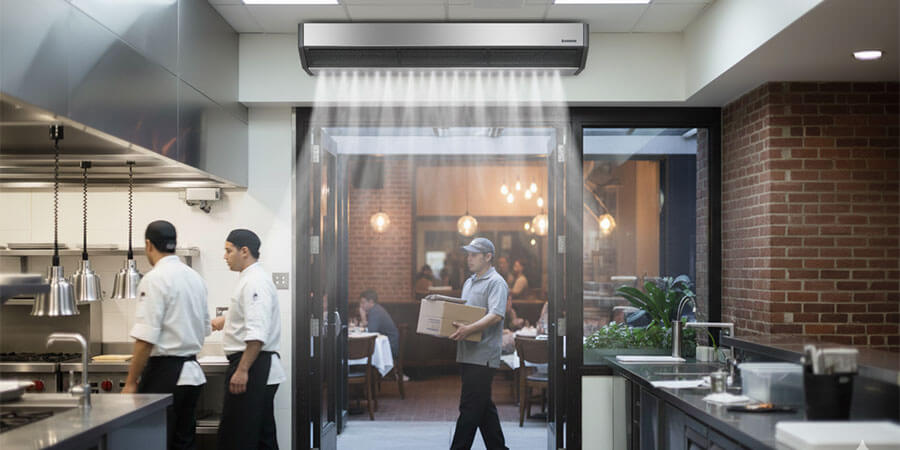
Invisible air barriers that protect indoor environments from pests, dust, and temperature loss in commercial spaces
Commercial air curtains project invisible high-velocity airstreams to maintain environmental separation at doorways, proven to cut HVAC infiltration by 80%, exclude 90%+ insects/dust, and save 20-30% on energy costs. Covering heated/unheated types for various applications like main entrances to dishwashers, single/three phase power, separation heights 3-16 ft, and features like HEPA/UVC filtration, this guide enables precise selection by door size, traffic, and application for retail/foodservice facilities.
Overview
Commercial air curtains, also known as air doors, mount above doorways to project downward airstreams that minimize air exchange between environments. They reduce energy costs by limiting heated or cooled air loss, block flying insects and dust at high-traffic entries, and support sanitation in foodservice and industrial settings. Available in heated models for cold climates and unheated for milder conditions, they suit applications from concession stands to shipping docks while allowing unobstructed visibility and access.
Types of Commercial Air Curtains
Air curtains divide into two primary types based on heating capability, each optimized for climate and energy needs.
Heated Air Curtains
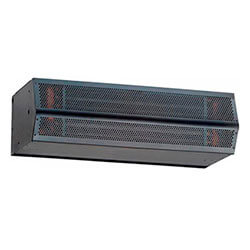
Heated units incorporate electric coils to warm the airstream, countering cold infiltration in winter while providing the primary separation barrier year-round.
- Best Uses: Main entrances, lobbies, and employee doors in cold regions or conditioned spaces.
- Key Features: Electric heating elements (208-480V), thermostat controls, high-velocity blowers for effective separation up to 14-16 ft heights.
- Pros: Maintains indoor warmth during door openings, dual-purpose for temperature and pest control, energy-efficient for HVAC protection.
- Cons: Higher energy consumption due to heating, requires compatible electrical service, larger power draw in three-phase options.
Unheated Air Curtains
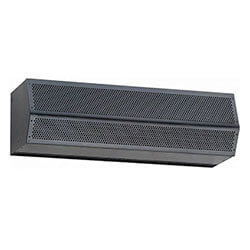
Unheated models focus on ambient air separation using powerful blowers alone, ideal for milder climates or refrigeration preservation.
- Best Uses: Kitchen entrances, drive-thru windows, walk-in coolers, and conveyor systems.
- Key Features: Compact motors (1/6-1 HP), adjustable airflow, quiet operation for customer-facing areas.
- Pros: Lower operating costs, simpler installation, effective for insect/dust control without heating overhead.
- Cons: Less effective against extreme temperature differentials, may require higher velocity for cold storage.
| Type: | Primary Environment: | Power Draw: | Door Height Coverage: | Best Applications: |
| Heated | Cold climates, heated interiors | High (kW heating) | 8-16 ft | Entrances, lobbies |
| Unheated | Mild climates, refrigeration | Low (blower only) | 3-12 ft | Kitchens, coolers |
Commercial Air Curtain Applications
Air curtains are deployed across various commercial settings, grouped by traffic volume and environmental needs. Each application optimizes for door height, traffic frequency, and climate, with specific width, phase, and feature recommendations.
High-Pedestrian Traffic (Main Entrances, Employee Service Doors, Lobbies, Shopping Areas)
Customer-facing and staff entries requiring aesthetic, quiet, and durable units for continuous human movement.
- Traffic Level: High to continuous pedestrian flows in retail/hospitality settings.
- Key Considerations: 48-96+ inch widths for door overlaps, heated models for cold climates, switch included, black/silver/white finishes.
- Door Height Match: Environmental separation 9-14 ft, insect blocking 9-14 ft.
- Benefits: Maximizes comfort/energy savings in busy entries, reduces draft complaints.
| Application: | Recommended Width: | Preferred Phase: | Key Benefit: |
| Main Entrances | 48-96" | Single | Pest/temperature control |
| Employee Doors | 36-72" | Single | Hygiene maintenance |
| Lobbies | 60-84" | Single | Welcoming access |
| Shopping Cart Areas | 72-96" | Single | Retail convenience |
Industrial Loading (Shipping Areas, Dock Doors)
Heavy-duty installations for vehicle/equipment loading in warehouses and distribution centers.
- Traffic Level: High-volume vehicle and manual loading/unloading.
- Key Considerations: 98-146+ inch widths for large bays, three-phase power, durable mounting brackets, adjustable airflow.
- Door Height Match: Environmental separation 14-16 ft, insect blocking 12-14 ft.
- Benefits: Prevents contamination of goods, maintains warehouse climate for inventory protection.
| Application: | Recommended Width: | Preferred Phase: | Key Benefit: |
| Shipping Areas | 98-120" | Three | Dust exclusion |
| Dock Doors | 120-146" | Three | Vehicle loading |
Foodservice & Refrigeration (Walk-In Coolers, Kitchen Entrances, Concession Stands, Drive-Thrus)
Hygiene and temperature-critical zones in restaurants, QSR, and catering where food safety intersects.
- Traffic Level: Frequent staff/customer access for service/prep.
- Key Considerations: Unheated for temp preservation, UVC for sanitation, ionizer for air quality, compact depths 6-14 inches.
- Door Height Match: Environmental separation 7-12 ft, insect blocking 7-12 ft.
- Benefits: Eliminates odor migration, reduces energy on compressors, ensures hygiene compliance.
| Application: | Recommended Width: | Preferred Phase: | Key Benefit: |
| Walk-In Coolers | 36-60" | Single | Frost reduction |
| Kitchen Entrances | 36-48" | Single | Odor control |
| Concession Stands | 25-42" | Single | Pest blocking |
| Drive-Thrus | 20-36" | Single | Customer comfort |
Production & Process (Conveyor Systems, Dishwashers)
Automated or washdown areas in food processing and dishwashing operations.
- Traffic Level: Continuous mechanical or low-manual access.
- Key Considerations: IP-rated for moisture, HEPA for particle control, three-phase for high-power conveyor belts.
- Door Height Match: Environmental separation 3-9 ft, insect blocking 3-9 ft.
- Benefits: Prevents cross-contamination in processing, extends equipment life.
| Application: | Recommended Width: | Preferred Phase: | Key Benefit: |
| Conveyor Systems | 60-84" | Three | Particle exclusion |
| Dishwashers | 30-48" | Single | Hygiene |
Specialized Environments (Clean Rooms, Auto Plants)
Controlled or hazardous zones requiring strict air quality and separation standards.
- Traffic Level: Controlled access with contamination sensitivity.
- Key Considerations: HEPA filtration for sterile areas, UVC for pathogen elimination, specialized finishes.
- Door Height Match: Environmental separation 7-12 ft, insect blocking 9-12 ft.
- Benefits: Maintains sterile/product integrity, prevents environmental mixing.
| Application: | Recommended Width: | Preferred Phase: | Key Benefit: |
| Clean Rooms | 36-72" | Single | Air purity |
| Auto Plants | 60-96" | Three | Contaminant block |
Features & Accessories
From 551 units and 101 parts categories, features enhance separation, filtration, and control for specific applications.
- Power Phase/Voltage: Single phase (392 units: 115/120/208/230/240V) for standard outlets; three phase (179 units: 208/230/460/480V) for high-power/large/heated.
- Motor/Blower (HP): 1/6-3 HP with 1-3 motors; higher HP for taller doors (e.g., 3 HP for 14-16 ft).
- Air Velocity (FPM): 2000-4000 FPM adjustable; 3000+ for insect blocking, optimized per door height.
- Heights: Unit heights 6-15 inches (6-8": 158 units, 10-14": 252, 15": 141); separation up to 16 ft env, 14 ft insect.
| Width Range: | Max Env Separation (ft): | Max Insect Blocking (ft): | Depth Range: |
| 20-36" | 3-9 | 3-9 | 6-10" |
| 37-60" | 5-12 | 5-12 | 11-14" |
| 61-96" | 7-14 | 7-14 | 15-20" |
| 98-146" | 9-16 | 9-14 | 21-30" |
- Filtration Enhancements: HEPA (22 units) for 99.97% particle removal in clean rooms; UVC (32 units) for 99.99% pathogen kill; Ionizer (12 units) for air quality in humid areas.
- Controls & Automation: Switch included, reed/magnetic/plunger door sensors, thermostats, time-delay relays, remote panels for occupancy activation.
- Mounting/Accessories: Brackets (19 types, 3-23" extensions), transom kits, extension plates; finishes black, silver, white.
Selecting the Right Commercial Air Curtain
Production & Capacity
Airflow (CFM) and velocity (FPM) match door height/traffic:
- Low-volume (cafes): 1000-2000 CFM, 3-7 ft coverage.
- Medium (restaurants): 2000-4000 CFM, 8-12 ft.
- High-volume (docks): 5000+ CFM, 12-16 ft.
Space & Utilities
- Mounting: 6-8 inches above door; verify ceiling clearance.
- Electrical: Single phase for small/medium, three phase for large/heated.
- Width Matching: Unit width = door width + overlap.
Budget & Total Cost of Ownership
Cost & ROI Snapshot: Entry $800-2000 (unheated 36"); Mid $2000-5000 (heated 72"); Premium $5000+ (wide/filt). Operating $100-500/yr electricity + $200 maintenance. Break-Even Insight: Payback 6-18 mo via 20-30% HVAC savings, reduced pest control, 10-20% energy cut in cooling/heating.
Compliance & Safety
NSF/ETL for foodservice, grounded three-phase, IP washdown-rated, CO detectors for heated units.
Compliance & Safety
NSF/ETL certified; IP-rated for washdown; grounded three-phase wiring.
Installation & Maintenance
Installation Checklist
- Verify electrical requirements (phase/voltage) and ensure proper grounding per local codes.
- Confirm mounting height and ceiling clearance (minimum 6 inches above door).
- Securely install brackets or mounting hardware for stability.
- Connect and wire controls/switches safely.
- Level the unit front-to-back and test airstream angle (10-20° downward).
- Verify air velocity with anemometer and perform initial functionality check.
Care Schedule
| Task: | Frequency: | Notes: |
| Clean intake grilles | Daily/Weekly | Vacuum dust buildup. |
| Inspect filters | Monthly | Replace HEPA/UVC as needed. |
| Check motors/blowers | Quarterly | Lubricate bearings. |
| Test controls | Quarterly | Verify switch/thermostat function. |
| Professional service | Annually | Full inspection including electrical safety, airflow calibration, and component checks. |
Troubleshooting Highlights
- Weak barrier: Adjust velocity, check filters/motors.
- Noisy operation: Clean/lubricate blower, balance airstream.
- Uneven heating: Calibrate thermostat, check coils.
- Power issues: Verify phase wiring, breakers.
Frequently Asked Questions
Heated or unheated for restaurant kitchen entrances?
Unheated suits most kitchens for energy efficiency and odor isolation; heated recommended only for extreme northern climates with high customer turnover.
Single phase vs three phase power?
Single phase (115-240V) suffices for <72" doors/low velocity; three phase (208-480V) essential for wider/heated units in industrial docks to handle higher loads safely.
What door height can air curtains cover?
Models cover 3-16 ft environmentally, 3-14 ft for insects; select by width (e.g., 98-146" for 14+ ft) and velocity 3000+ FPM for optimal barrier strength.
Do air curtains require switches?
Yes, typically door-activated reed/magnetic sensors for automation; manual/remote options available for non-standard setups.
How much energy do they use?
0.5-5 kW/hour depending on HP (1/6-3) and heating; ROI achieved in 6-18 months via 20-30% HVAC reduction and eliminated pest barriers.
Can they include air purification?
Yes, HEPA (22 units) for 99.97% particles in clean rooms, UVC (32 units) for pathogen elimination, ionizer (12 units) for quality in humid kitchens.
Mounting options for low ceilings?
Use transom brackets with 3-23" extensions or low-profile models 6-10" depth; extension plates for offset mounting.
Maintenance for filtration features?
Monthly HEPA/UVC/ionizer inspection/replacement; quarterly motor checks; annual professional service for optimal lifespan.
Best for walk-in coolers?
Unheated high-velocity (3500+ FPM) with UVC filtration to minimize frost buildup and block contaminants during frequent openings.
Noise levels in customer areas?
QuietPro series under 65 dB; position remote from dining; test decibel levels pre-install for noise-sensitive lobbies.
Shop Air Curtains
- Electric Air Curtains - Complete selection of heated and unheated units
- Heated Air Curtains - Warm air barriers for cold climates
- Unheated Air Curtains - Ambient separation for kitchens/coolers
Related Guides & Resources
- Commercial Refrigeration Guide - Walk-in coolers and temperature control
- Restaurant Equipment Parts Guide - Maintenance for entryway systems
Share This!